
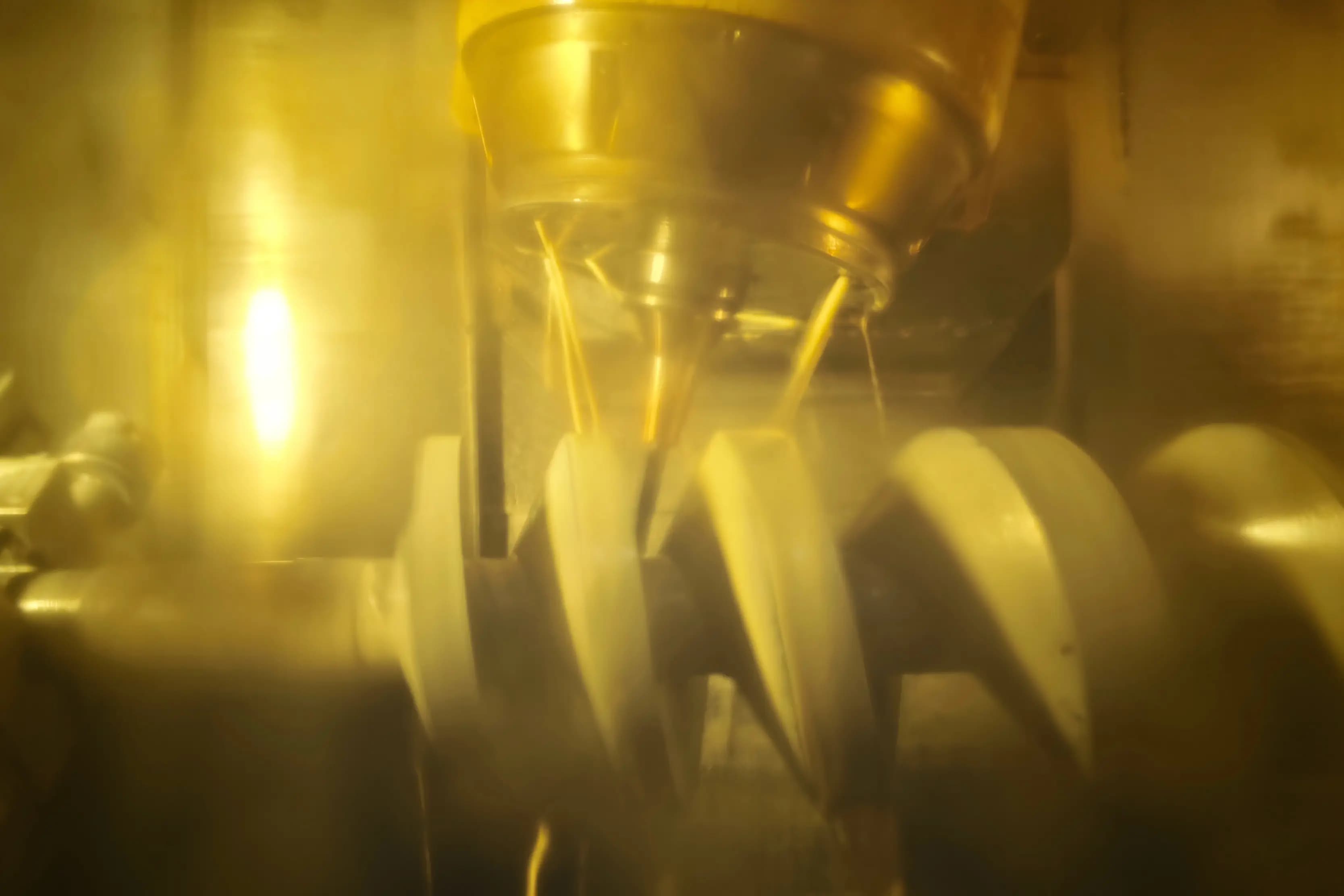
The Rotor That Taught Me How Much Process Route Costs
I still remember a compressor rotor I machined early in my career. We did it the traditional way, and just getting through roughing took most of a week.
The route itself was simple. Rough-turn the journals on a lathe, ship the rotor out to a subcontractor for profile roughing — they always left about 3 mm on the lobes because cutting deeper risks scrapping the rotor — then bring it back to our Mazak to rough the lobes down to 0.5 mm, semi-finish, and finish. Cutting was fine. The days went into the trucking and the wait for the subcontractor's schedule.
The first improvement came when we stopped sending the profile out. I wrote a CAM program that let us rough the lobes on a 3-axis machining center in-house with 1 mm of stock left for finishing within a couple of days. Once the part stayed in-house, there is no more freight bill and no more subcontractor wait.
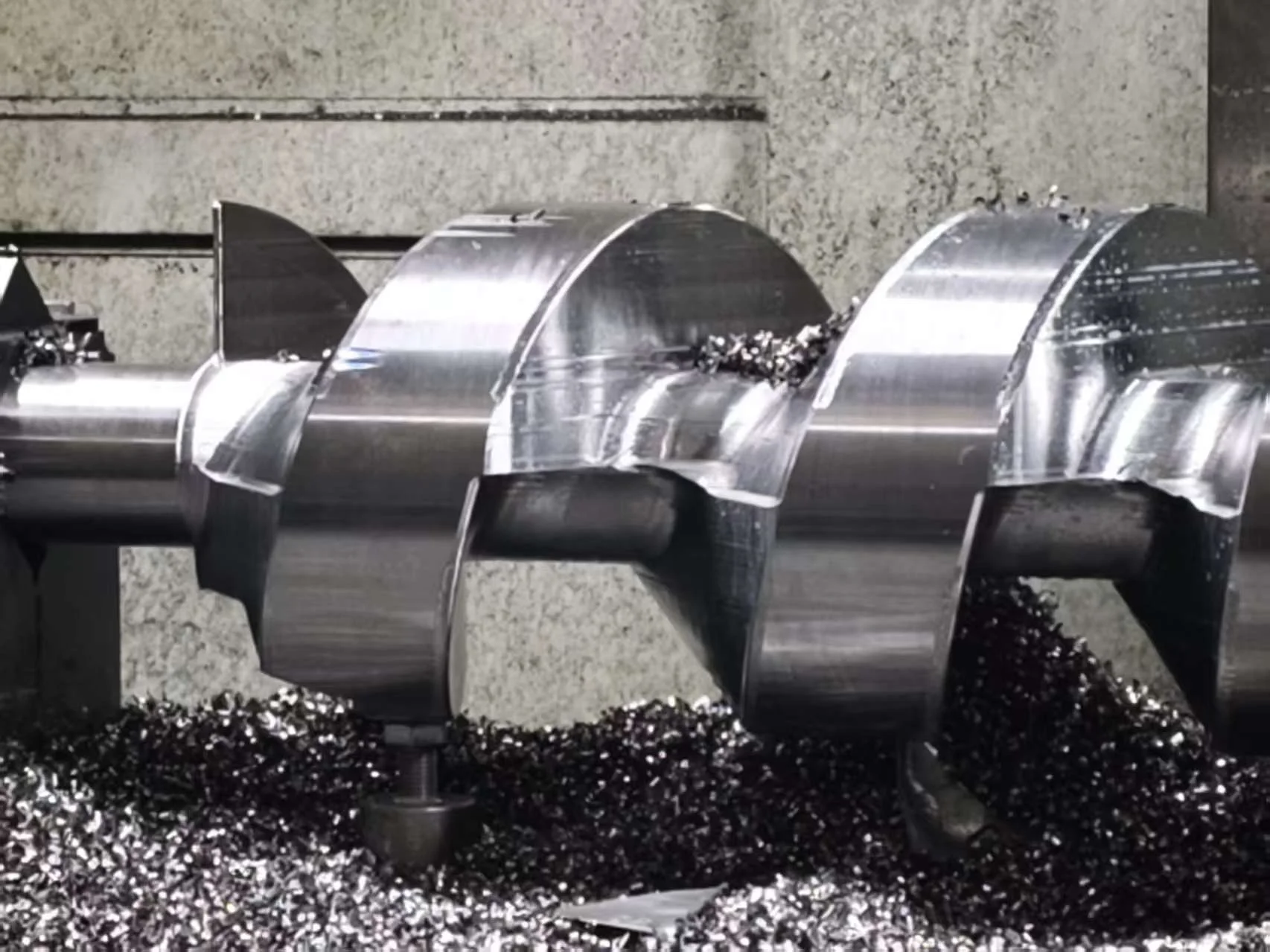
Not long after, a machine tool rep walked us through a turn-mill solution. It was impressive — roughing operations that used to tie up a machine all day were finishing in about an hour. But once we added up the machine payment, tooling, and application support, the cost per part came out several times higher than the route we already had. Flexibility was the other concern: rotor geometry needs to stay frozen, and every revision would mean another bill of application support.
A process can look more efficient on the shop floor and still cost more per part: on a complex rotating part, cycle time is usually the smallest line on the cost sheet, and the setup count is what drives it. Every extra fixture transfer adds probing time and one more chance to scrap the workpiece.
A Mazak Integrex pays back on some parts and loses money on others, and where that line falls has more to do with the part than with the machine spec sheet.
The Cost of Additional Setups
Every extra setup costs more than the minutes the machine sits idle. Each fixture transfer adds setup labor, a probing cycle, a scheduling slot, and another tolerance stack to manage. These costs don't appear as line items on a quote. The unit price still carries them.
| Cost category | Typical impact per extra setup | Where it shows up |
|---|---|---|
| Setup labor | 30–60 min on a 3-axis VMC | Direct hours on the route sheet |
| Re-fixturing positional error | 0.005–0.02 mm depending on workholding | Tolerance stack between features in different setups |
| Inter-operation queue | Hours to days, depending on shop load | Lead time, not unit cost |
| Intermediate inspection | 15–45 min per handoff | Overhead, often unbilled but real |
1. Setup Time
On a 3-axis machining center, a moderately complex part takes 30 to 60 minutes to set up — strip the previous fixture, mount the new workholding, locate the part, set tool offsets, prove out the first piece. Stack five setups across the manufacturing route and that's two and a half to five hours of preparation before any cutting time gets billed.
A multi-tasking machine like the Integrex doesn't make that work disappear — it usually makes the first setup harder, because the fixturing and process plan have to cover everything at once. But you only do it once. The repeat setups across the route are what go away.
A spindle probe compresses first-piece proving from 20–30 minutes of manual dial-indication and tool-touch-off down to a 5–10 minute probing cycle, and on repeat parts the manual portion disappears almost entirely. The catch is capital: a touch-trigger system with the macro work to integrate it cleanly runs into the low five figures per machine, and the probing routines themselves have to be written and proven out like any other CAM program. The payback is larger on a turn-mill. The machine can re-locate the part in its own coordinate system between operations, so any thermal drift or fixture creep across an 8-hour cycle gets caught and compensated for rather than carried into the next feature.
2. Positional Variation Introduced by Re-Fixturing
Every time you unclamp and re-clamp a part, you introduce a little positional error. Precision workholding, dial indication, and probing all help, but no setup puts the part back in exactly the same place. Add up enough setups and the small numbers stop being small.
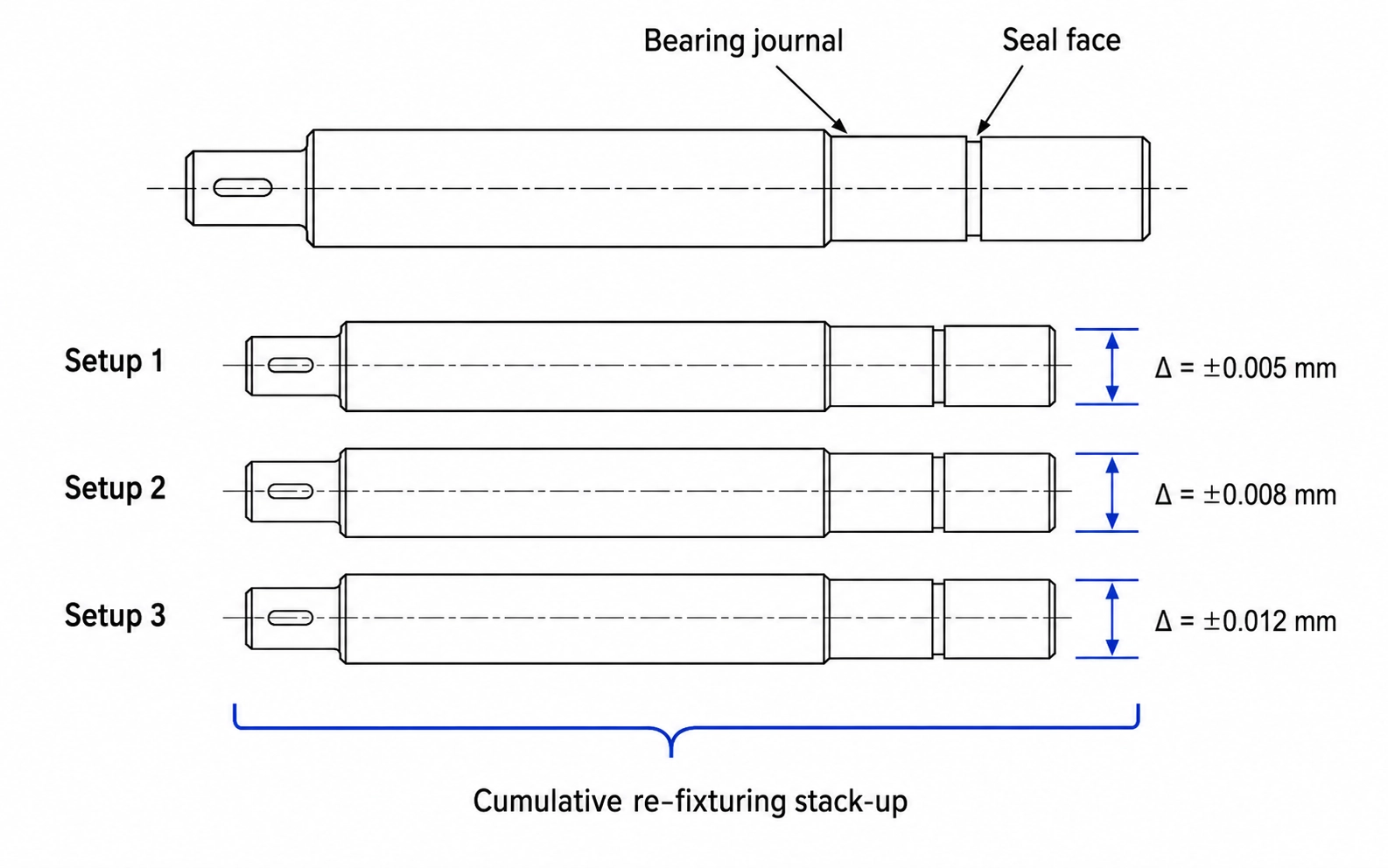
This matters most when two critical features have to hold a tight relationship to each other. A bearing journal and the mating seal face, for example — machine them in separate setups and you've just added a re-fixturing error budget to a callout that doesn't have room for one.
Machine them in one setup and the re-fixturing error drops out of the budget entirely. Both features come off one coordinate system, so the only positional error left is the machine's own — spindle accuracy, thermal drift, and tool deflection. Those we have data on from every part we run; a re-fixturing stack-up we don't.
3. Queue Time Between Operations
On most complex parts, the waiting between operations runs longer than the cutting itself. The next machine has to free up, and the inspector and scheduler both have to find time for the part. On the rotor I described above, the cumulative cut time was a few hours; the calendar time from raw bar to finished part was close to two weeks.
A part with five setups across four machines can spend days in queue between operations even when the cutting itself takes a few hours.
Consolidate those operations onto one machine and the inter-operation queue collapses. The cycle inside the machine isn't necessarily shorter, but the calendar time from raw stock to finished part is.
4. Inspection and Verification Overhead
More operations mean more inspection. On critical parts, key dimensions get checked before the work moves on, especially when it crosses departments, machines, or external suppliers. Each handoff brings inspection planning, measurement setup, paperwork, sometimes a CMM slot. Each individual check is small, but five or six of them across a route add up to hours.
Consolidating features into one setup cuts the handoffs, which cuts the intermediate inspections. Final verification still has to happen, but the running checks in the middle largely don't.
When Does Multi-Tasking Machining Make Sense?
An Integrex-class machine is a big check to write, and it's the wrong answer for plenty of parts. Conventional turning and milling still cover most of what shops make. But once a part gets complex enough that the route grows extra setups, extra handling, and extra calendar time, the math starts to flip. These are the cases where I'd push a customer toward a turn-mill.
Components Combining Turning and Milling Operations
Compressor rotors are a good example, because the relationship between the lobe profile and the journals matters as much as the features themselves.
The conventional route machines the profile first and turns the journals in a separate setup. Holding the relationship between them depends on the center holes and on whatever happens during re-fixturing. Anything that drifts here shows up later as runout on the assembly.
On a turn-mill, the profile and the journals come off one setup — one coordinate system, one fixture, no transfer of accuracy from one operation to the next. The profile-to-journal relationship is set by the machine's own positioning, not by how well the part was re-located between operations.
Components with Tight Feature Relationships
Compressor housings are the same story. The rotor bore and the dowel pin holes have to hold a tight positional relationship because the dowels set the housing's location at assembly. Whatever drift exists between those features ends up in the rotor's running clearance.
A conventional route makes the bore and the dowel holes in separate operations. The final relationship rides on machining accuracy and on however consistently the part gets re-located between setups.
Hold both features in one setup on a multi-tasking machine and the re-location term is no longer in the stack-up. The relationship is set inside a single machining process instead of carried across the route.
That is also why our dry screw pump housing machining route keeps the twin bores, dowel references, and critical faces tied to one datum strategy instead of treating each feature as a separate machining problem.
Components Sensitive to Repeated Clamping
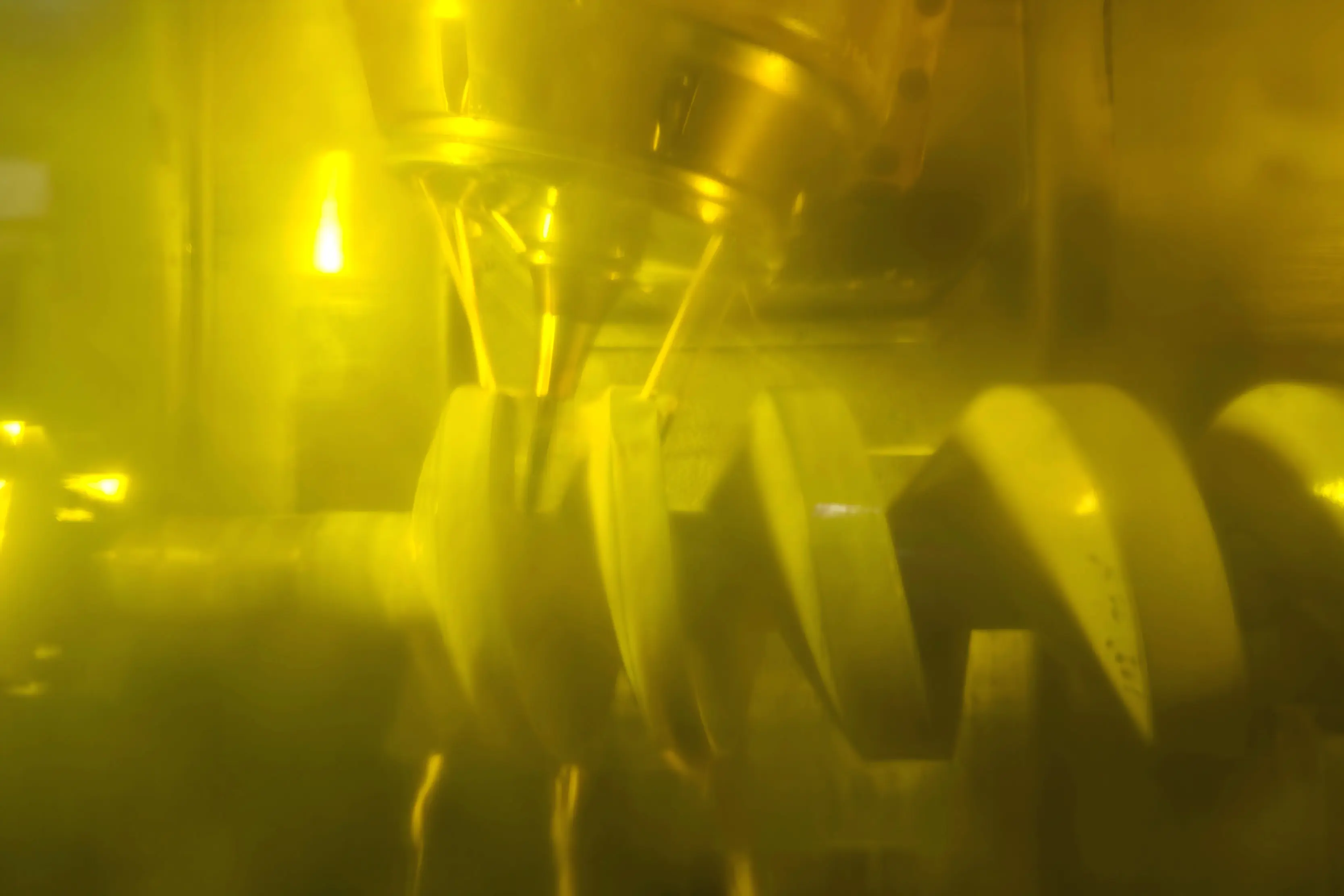
The case I see most often is a deep housing where the bore is too long to reach from one side, so the usual move is to flip the part and finish from the other end. The hard part is keeping the two halves of the bore aligned. A small shift in part location leaves a witness mark where the two passes meet, and sometimes more than a witness mark — the bore axis is no longer straight.
A 4-axis horizontal handles this differently. The part stays clamped; the rotary table presents it from both sides. No second setup, no alignment to lose.
The same logic covers thin-wall castings, slender shafts, and stainless or titanium parts that don't like clamping pressure. Every additional fixturing cycle is another chance to move the part or distort it.
Low-Volume, High-Value Components
Compressor rotors don't run in big quantities, but the blanks are expensive. By the time the material is in and the roughing is done, there's already a lot of value in the workpiece.
Scrap the part at that stage and you've lost every machining hour that went into it, not only the blank.
For parts like these, customers care more about process stability than about the lowest hourly rate. A route with fewer setups and lower dimensional risk is often the cheaper option overall, even when the machine itself runs at a higher rate.
When Multi-Tasking Is Not the Best Option
The cases where multi-tasking loses are just as clear-cut as the ones where it wins.
| Multi-tasking usually wins when… | A conventional route usually wins when… | Why this is the deciding factor |
|---|---|---|
| The part combines turning and milling features | All features fit a single straightforward 3-axis setup | Each cross-machine move adds a full setup-and-probe cycle |
| Tight positional relationships between bores, journals, sealing surfaces | Few critical feature-to-feature relationships | One coordinate system eliminates the re-fixturing term from the stack-up |
| Workpiece is high-value and scrap is costly | High-volume part where dedicated cells run in parallel | Process stability matters more than hourly rate once the blank carries value |
| Part is sensitive to repeated clamping (thin-wall, slender shafts) | Geometry is simple — flat plates, basic rotational parts | Each clamp cycle is another chance to distort or shift the part |
| Aggressive lead time, fewer handoffs preferred | Lead time is flexible | Inter-operation queue is usually the largest portion of total lead time |
Simple Parts with Limited Operations
If the part only needs basic turning or straightforward milling, a turn-mill adds nothing the simpler machine doesn't already cover.
A flat plate machined on one face, or a shaft that's all rotational features, runs faster and cheaper on a dedicated machining center or lathe. The extra capability of an Integrex is just capital you're not using.
High-Volume Production
At high volume, dedicated cells let turning, milling, grinding, and inspection run in parallel across separate machines. Add automation on top of that and the parallel route beats single-machine consolidation on cost per part.
Components Well Suited to Conventional Machining
Some parts don't need what a turn-mill offers. If every critical feature is reachable in a clean 3-axis setup and there aren't many positional ties between operations, a conventional machining center is the right answer.
The right process depends on geometry, tolerances, volume, and delivery, and the process choice usually matters more than which machine the work runs on.
Evaluating Whether Multi-Tasking Machining Makes Sense
No single rule decides whether a part belongs on a multi-tasking machine. Geometry, tolerances, volume, material, and how hard the delivery is being pushed all feed in.
When a new drawing comes in, this is the checklist I run it through. If several items light up, it's worth talking through both routes with your supplier before locking one in.
Checklist: is this part a multi-tasking candidate?
- Confirm the part combines turning and milling features — every cross-machine move adds a setup, a probing cycle, and a fresh chance to lose the feature-to-feature relationship.
- List the tight positional callouts between features — bores, journals, and sealing surfaces sharing a tolerance are easier to control in a single coordinate system than across re-fixturing.
- Price the value sitting in the blank by mid-route — high-value forgings or pre-machined billets shift the calculus toward process reliability over the lowest hourly rate.
- Flag any clamping-sensitive geometry — thin-wall castings, slender shafts, and certain stainless or titanium grades accumulate distortion every time they get re-clamped.
- Check how hard the lead time is being pushed — inter-operation queue is usually the largest portion of total lead time, and consolidating setups collapses it.
Comparing routes at the quoting stage usually paints a truer picture of cost than comparing machine-hour rates.
What This Means for Your Next RFQ
How much information you put on an RFQ shapes the process your supplier ends up quoting. A few details that change the answer:
Include Datums, Not Just Dimensions
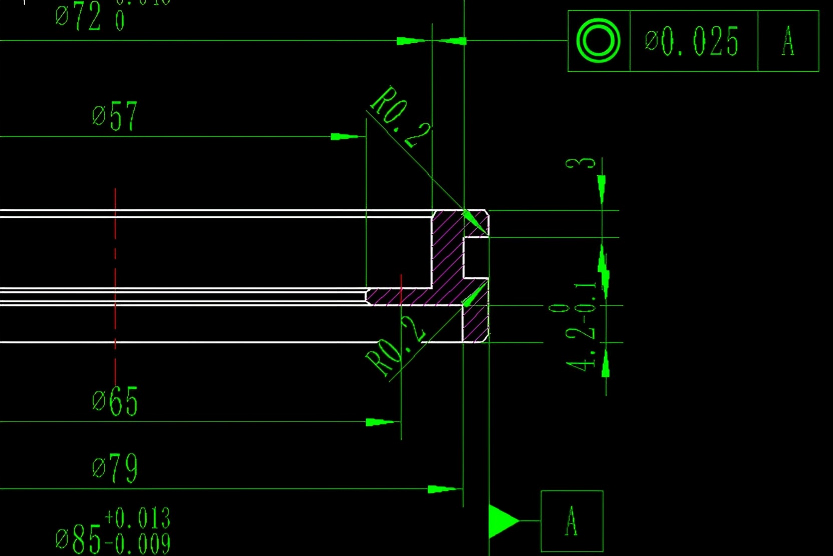
Dimensions say what to hit. Datums say how the critical features relate to each other.
When the datum structure is on the drawing, the supplier can plan setup strategy, fixturing, and machining sequence properly. When it isn't, the supplier prices in the uncertainty.
Discuss the Manufacturing Route, Not Just Cycle Time
Cycle time is only one slice of the cost. On complex parts, the setup count and the number of machine transfers move lead time, inspection load, and process stability more than cutting time does. Asking how a supplier plans to make the part tells you more than asking for a per-hour rate.
Evaluate Total Lead Time
Actual cutting time is often a small slice of the schedule. Material lead time, setup planning, inspection, and work-in-process delays all show up in the delivery date. Total lead time is a more useful comparison than machining time on its own.
A good quote tells you what the part costs, how the supplier intends to make it, and how long the whole thing will take.
The Capability Behind the Machine
A Mazak Integrex is a capable machine, but the machine isn't what decides whether the job goes well. A poorly planned process on a great machine still ships ugly parts, and a well-planned conventional route can outperform it.
On complex parts, the planning means looking at the whole route — setups, workholding, feature sequence, tool access, thermal stability, inspection — not at any one operation in isolation.
When you pick a supplier, the machine list matters less than whether the engineering team has lived through enough multi-tasking jobs to know when to reach for it and when to leave it on the floor.
If a part combines turning and milling, holds tight relationships between critical features, or involves complex rotating geometry, both routes are worth pricing before you commit.
At SCPM that comparison is part of every quote review. If you'd like a second opinion on a component, send us your drawing and we'll walk through the options, the trade-offs, and the route we'd take in the shop before we cut metal.
FAQ
Is a Mazak Integrex worth it for low-volume parts?
Often yes, but for a different reason than people expect. The payback isn't in cycle time — it's in scrap risk and lead time. On a high-value rotor blank with five planned setups, one mid-route mistake costs more than the entire turn-mill cycle. Consolidating setups protects the value already invested in the workpiece.
How many setups is too many on a complex part?
There's no single number, but on rotating parts with tight feature relationships, anything past three setups starts adding visible cost from re-fixturing error, queue time, and inspection handoffs. If the route shows five or more, it's worth pricing a turn-mill alternative before committing.
Can I ask a supplier to quote both a conventional and a multi-tasking route?
Yes, and you should when the part is borderline. A serious supplier will quote both and explain where the cost lines sit differently — setup labor on one side, machine-hour rate on the other. If a supplier only quotes one route without discussing the other, that's information about their planning depth.
Does multi-tasking always reduce total lead time?
No. The cycle inside the Integrex can be longer than any single conventional operation, because the machine is doing more work per part. What collapses is the between-operation time — queue waits, inter-departmental handoffs, inspection scheduling. On parts that move across four or five machines conventionally, that's usually where the lead-time savings come from.

Share your thought
Your email is kept private and only used to notify you of replies.