
Why housing tolerances can change a machining quote
Dry screw pump housing tolerances change a machining quote when the drawing changes how the housing must be machined, held, measured, or accepted.
In my past housing quote reviews, a tight callout did not always mean the same thing. On a simple bracket, a tight dimension may only add inspection time. On a dry screw pump housing, the same kind of callout can push the job out of a normal 4-axis route and into a higher-risk process: a more stable fixture, extra CMM points, more probing during boring, a grinding step, or a pause before quote because the datum frame is not clear enough.
That is why we do not treat every tight number as equal. A 0.01 mm note on twin-bore parallelism may protect rotor-to-bore clearance when the rotor OD, bore ID, and clearance budget were designed around it. The same 0.01 mm habit on a non-functional face or a dimension with generous assembly clearance may only reduce yield. In quote review, our job is to separate the functional tolerance from the copied one before the buyer pays for accuracy that the pump does not use.
The examples in this article come from my past experience reviewing and producing dry screw vacuum pump housings. They are not presented as outside customer case studies.
The housing tolerances we check before quoting
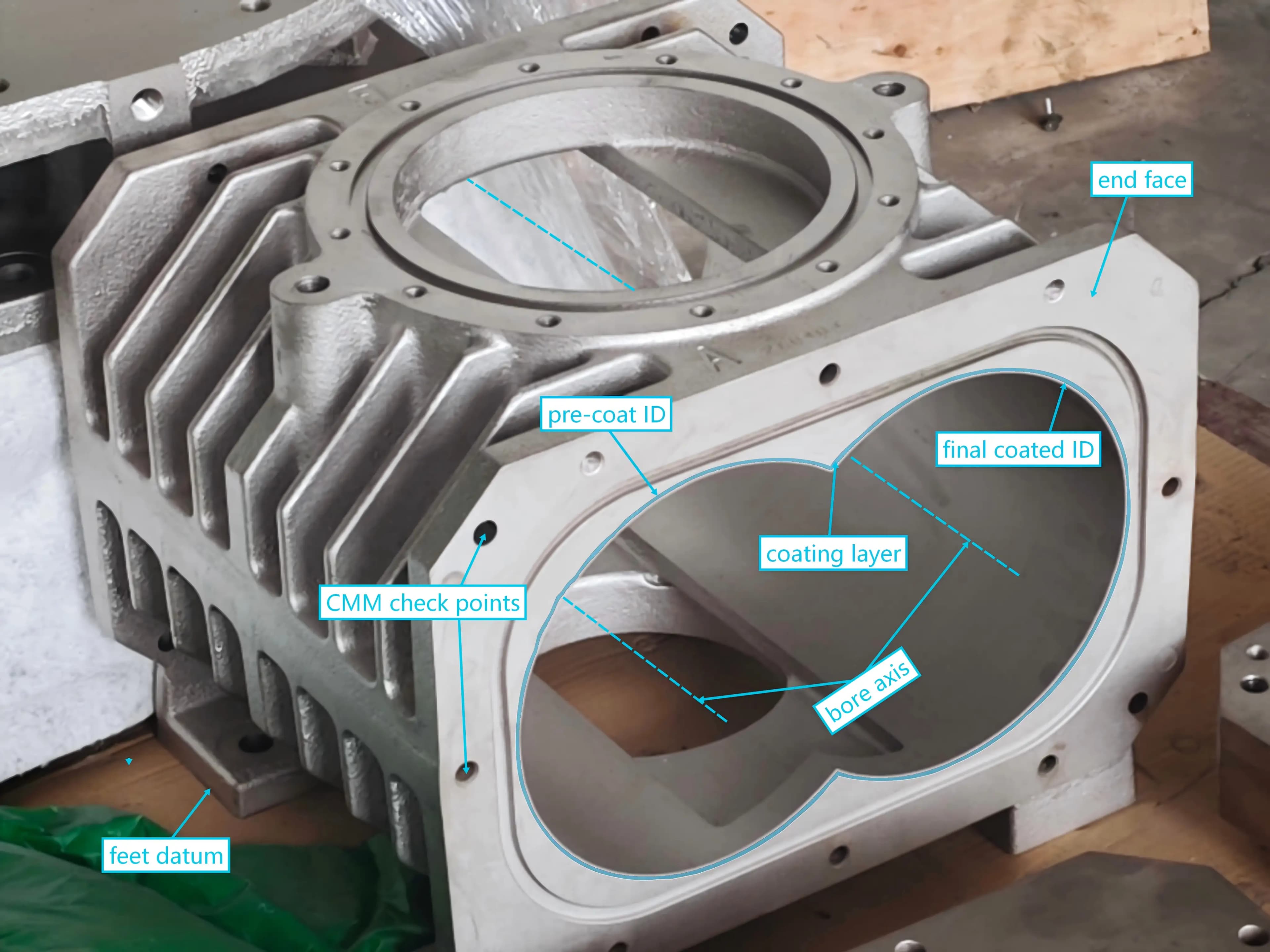
Before quoting a dry screw pump housing, our first tolerance pass goes to the features that can change the process plan: the two bores, the end faces, the datum chain, dowel or pin-hole position, mounting feet, and coated bore final size.
This is not a pump-design checklist. It is the machining supplier's quote checklist: what has to be clear enough for us to price the housing without hiding assumptions.
| Tolerance or feature | Why it can change the quote | What we check before quote | Typical route impact |
|---|---|---|---|
| Twin-bore parallelism | Controls how the two bore axes relate over length | Is the number tied to rotor and bore clearance, or copied from another drawing? | More stable fixture, more probing, CMM verification |
| Bore center distance | Controls rotor relationship and assembly fit | Is the tolerance functional, or tighter than the clearance budget needs? | Lower yield, more CMM time, possible OEM confirmation |
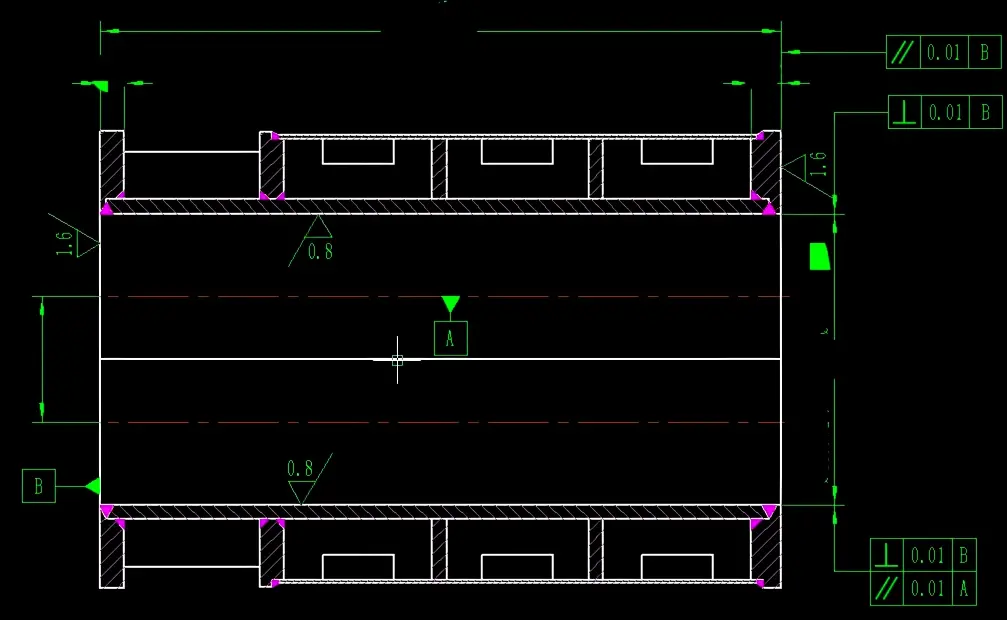
| Bore-to-end-face perpendicularity | Connects bore geometry to cover or flange assembly | Which face is the datum, and how will it be inspected? | Different machining sequence and datum setup |
| End-face flatness or parallelism | Controls sealing and mating quality on functional faces | Is this a sealing or mating face, or only a non-functional surface? | Milling may become grinding if the callout is strict |
| Dowel or pin-hole position | Sets repeatable end-cover alignment | Does the hole pattern reference the same datum frame as the bores? | CMM program expands to include bore/face/hole relationship |
| Mounting-foot flatness | Affects how the housing sits in the machine or fixture | Is the foot a primary datum, or only a mounting surface? | Extra setup and face control before bore machining |
| Coated bore final size | Coating changes the finished ID | Is the drawing asking for size before coating or after coating? | Pre-coat machining allowance and final inspection plan |
For the full housing machining route, see the dry screw pump housing machining page. The twin-bore geometry is covered in more detail in our parallelism guide.
Where housing drawings usually become ambiguous
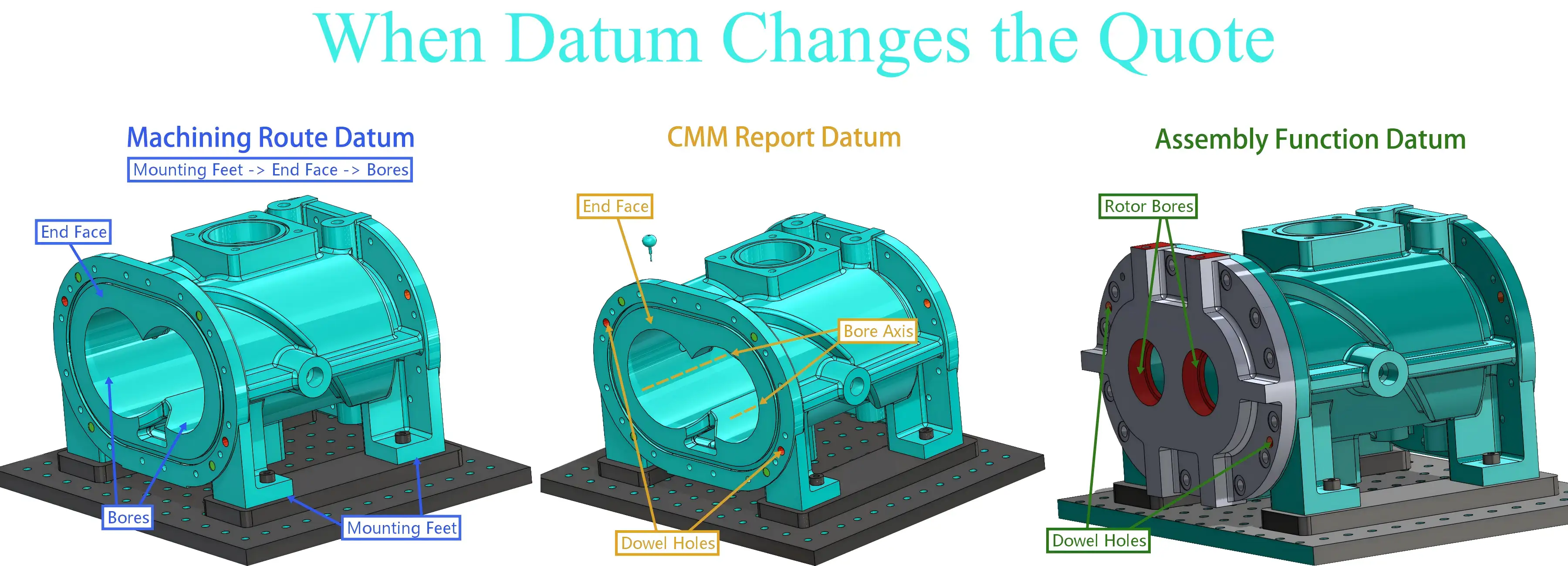
Housing drawings become risky when the machining datum, inspection datum, and functional assembly datum point to different references on paper.
In my past housing work, we usually started from the mounting feet, established the end faces, and then machined the bores from that frame. If the drawing wants a different reference frame, that is fine, but it needs to be visible before quote. A drawing that says "0.01 mm parallelism" without naming the reference can lead two suppliers to quote two different jobs: one may read the reference as the other bore, another may read it from the feet or an end face.
The same problem shows up in CMM reporting. A CMM report can measure many features, but it only answers the buyer's question when the datum frame matches the acceptance logic. If the buyer needs bore center distance, end-face perpendicularity, and dowel-hole position tied to one frame, we need to know that before we write the CMM program.
A 3D model mismatch can also pause the quote. In practical housing work, the model may not show every small fillet or corner break because of modeling limits, software performance, or the way the model was prepared. The casting or machining team may still add small radii or chamfers for manufacturability. If the buyer expects the final housing to match the model visually in every small radius, that expectation needs to be stated before the pilot order is judged.
At quote stage, we treat this as an acceptance question: which file controls the part, which geometry is reference only, and how small radii or corner breaks will be accepted.
Which tight callouts change machining or inspection cost
Tight callouts change machining or inspection cost when they reduce yield, make measurement uncertain, or force a different process route.
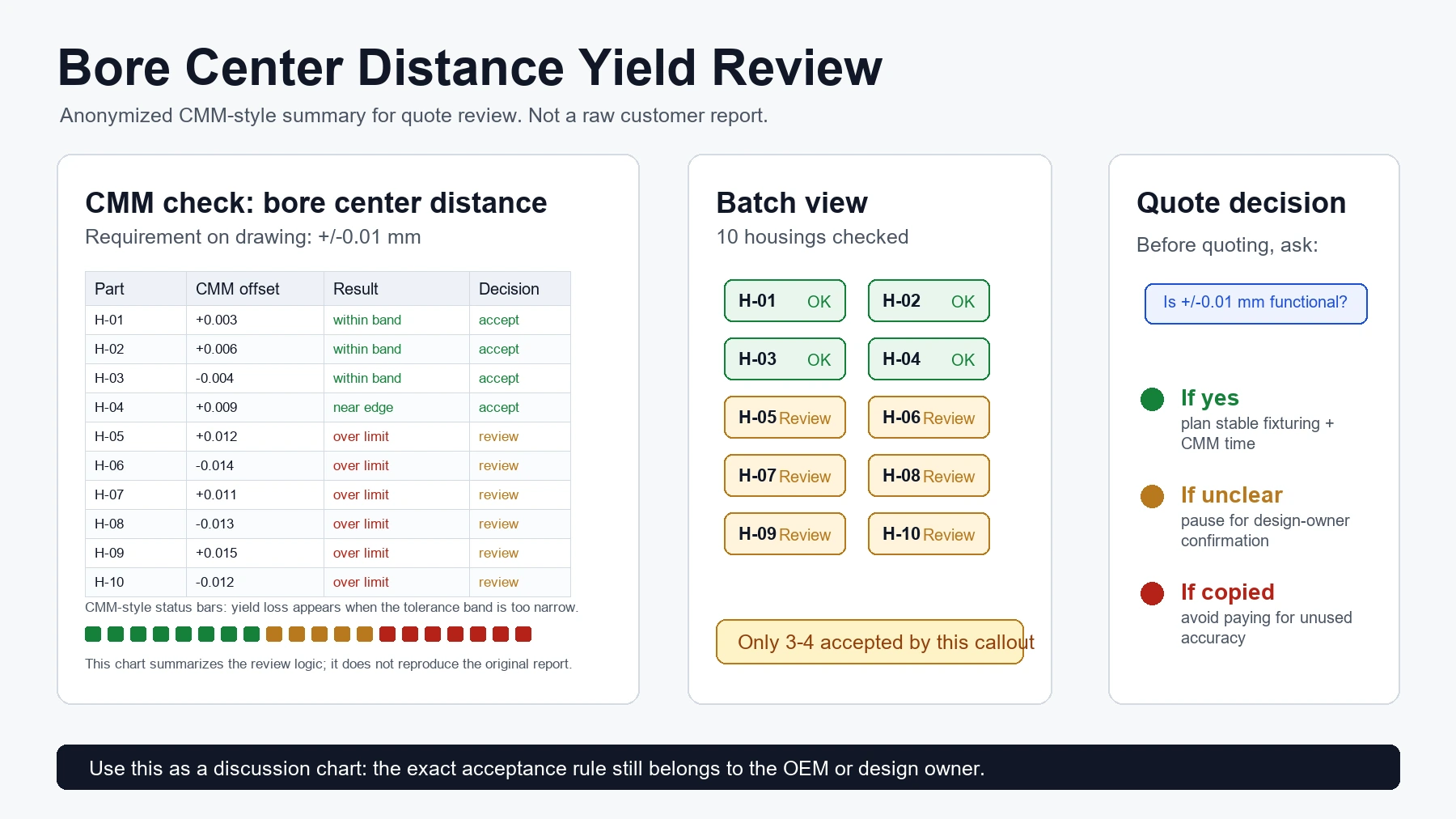
Bore center distance is the clearest example from our housing work. We once reviewed a housing design where the bore center distance was held at +/-0.01 mm. The tighter number looked safer in the drawing review, but the inspection method was close enough to the tolerance band that measurement uncertainty became part of the problem. Out of 10 housings, only 3-4 were accepted by that dimension.
Our shop-floor team believed the tolerance was stricter than the functional requirement. After internal calculation, one housing that had failed the bore center distance check was assembled and tested under the same operating condition. It showed no obvious performance loss and ran normally. With that evidence, the designer accepted that the dimension had been over-controlled and changed the drawing.
That example is why copied tight tolerances need design-owner confirmation before quote. We cannot decide the rotor clearance philosophy for the OEM. Our comment has to stay on the manufacturability side: "This +/-0.01 mm note will reduce yield and add inspection time. Is it functional, or was it inherited from an older template?"
| Tight callout | What may change in the shop | Supplier question before quote | Who confirms |
|---|---|---|---|
| Parallelism from 0.02 mm to 0.01 mm | More stable setup, more probing, tighter CMM review | Is this tied to rotor and bore clearance? | OEM or design owner |
| Bore center distance at +/-0.01 mm | Lower yield and longer inspection cycle | What performance limit does this tolerance protect? | OEM or design owner |
| End face moved from milling to grinding | Added operation and inspection of flatness/Ra | Is this face a sealing or mating face? | Buyer/design owner |
| Coated bore final size | Pre-coat ID allowance and post-coat acceptance | Is the final dimension checked before or after coating? | Buyer/design owner |
| Dowel holes tied to bore datum | Larger CMM program and tighter datum discipline | Should dowel position be reported with bore geometry? | Buyer/design owner |
Coated bore size and inspection timing
Coating changes the quote when the drawing controls the bore size after coating rather than the machined bore size before coating.
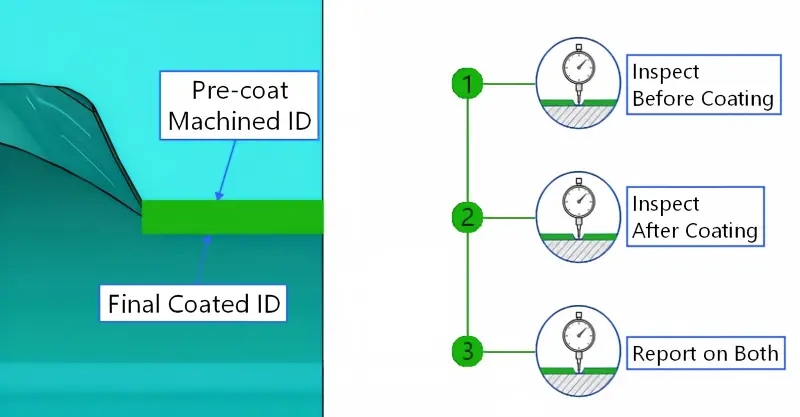
For dry screw pump housings, coating can change the bore ID chain. A bore machined to print before coating may be wrong after coating if the drawing does not define when the final dimension is accepted. In earlier housing DFM work, we noted that our own coated bores may need pre-coat ID allowance depending on the coating plan and final clearance. During quote review, we flag the question for customer confirmation: whether the bore ID is before coating or after coating.
The report question is practical: should the inspection package show only the final coated bore size, or should it also include the pre-coat machining size used to control allowance? In our process, pre-coat data may stay internal, while the buyer often needs only the final finished-part report. If the buyer wants both values, that request needs to be in the RFQ.
What buyers should send with a housing RFQ
A dry screw pump housing RFQ is easier to quote when the drawing package separates machining requirements, inspection requirements, and functional dimensions.
For the complete RFQ package, see our dry screw pump housing RFQ checklist, which covers the 2D drawing, 3D model, material notes, coating rules, CMM report scope, quantity, and mating-part context.
- 2D drawing - machinists and inspectors need the controlled dimensions, tolerances, datum frame, and notes that govern the job.
- 3D model and revision - CAM programming and blank preparation depend on the model; a revision mismatch can create a part that matches neither side's expectation.
- Material, heat-treatment, and coating notes - these set the blank route, tool choice, coating allowance, and inspection timing.
- Coating-before or coating-after acceptance - this tells us whether critical bore dimensions are accepted before coating, after coating, or both.
- CMM report scope - the useful scope names the features to be reported: bores, end faces, dowel holes, mounting feet, coated bore ID, or a full dimensional report.
- First-batch quantity and annual volume - one pilot housing and repeat production may not use the same blank or fixture economics.
- Known design-owner boundaries - if rotor clearance or pump performance geometry cannot be changed, that boundary keeps our comments on manufacturability.
Mating-part details are useful when they control how the housing is machined or accepted. If an end cover, front or rear plate, or mating assembly defines the housing datum, sealing face, dowel alignment, or CMM report scope, that note belongs in the RFQ. If the mating part does not control the housing geometry, the housing drawing package is usually enough for quote review.
What SCPM can review, and what the OEM must confirm
SCPM's RFQ review stays on the housing side: manufacturability, quote risk, copied tolerance risk, coating allowance, datum clarity, and inspection feasibility before order.
Pump-design decisions stay with the OEM or design owner: rotor clearance, pump performance geometry, screw rotor profiles, and proprietary stage features. If the buyer wants feedback from our dry screw vacuum pump production experience, we keep that feedback tied to manufacturability and inspection, not pump redesign.
Which dry screw pump housing tolerances change a machining quote?
The quote usually changes when tolerances affect the machining route, fixture, or inspection plan: twin-bore parallelism, bore center distance, bore-to-end-face perpendicularity, end-face flatness, dowel or pin-hole position, mounting-foot flatness, and coated bore final size.
Can SCPM decide which pump housing tolerances are necessary?
No. SCPM can flag over-tight, unclear, or hard-to-inspect housing tolerances before quote, but the OEM or design owner must confirm any dimension that changes pump performance, rotor clearance, or acceptance criteria.
Why can a +/-0.01 mm housing tolerance be expensive?
A +/-0.01 mm callout can add machining time, tighter fixture control, and CMM inspection time. If the dimension is not tied to a functional clearance or assembly datum, the buyer may pay for lower yield without improving pump performance.
Why do pump housing drawings become ambiguous before quoting?
Pump housing drawings become ambiguous when the machining datum, inspection datum, and functional assembly datum point to different references. The RFQ should state which file controls the part, which geometry is reference only, and how small radii or corner breaks will be accepted.
Should coated bore size be inspected before or after coating?
The drawing or RFQ should state whether the bore ID is accepted before coating, after coating, or both. If the final size is after coating, we need to plan the pre-coat machining allowance and the final inspection report around that requirement.
What should I send with a dry screw pump housing RFQ?
Send the 2D drawing, 3D model and revision, material or heat-treatment note, coating requirement, CMM report scope, first-batch quantity, annual volume, mating-part datum notes, and known design-owner boundaries. The clearer the datum and inspection logic, the fewer assumptions the quote needs.

Share your thought
Your email is kept private and only used to notify you of replies.