

The short answer: what should be in the RFQ package?
For a dry screw pump housing RFQ, start with the controlled 2D drawing and the matching 3D model. The package should also spell out the material, coating, finished-part material condition, inspection scope, quantity, timing, and any assembly context that affects how the housing will be accepted.
It is more detail than a simple file upload, but each item removes a possible assumption. If the supplier has to infer which file controls the part, whether the bore ID is accepted before or after coating, or whether the CMM report covers five critical features or every drawing dimension, the quote becomes a list of assumptions instead of a manufacturing plan.
This is the first-pass checklist we like to see before quoting a dry screw pump housing.
| RFQ item | Why it matters | If it is missing |
|---|---|---|
| 2D drawing | Controls dimensions, tolerances, datum, notes, material, surface finish, and inspection requirements | The supplier has to quote with hidden assumptions |
| 3D model | Helps with CAM programming, blank review, tool access, and fixture planning | Programming and access risks are harder to judge |
| Drawing and model revision | Keeps the print, model, and manufacturing route tied to the same part | A housing can match one file and fail another |
| Material specification | Sets the blank route, tool choice, corrosion risk, and coating logic | The quote may start from the wrong material baseline |
| Finished-part material condition | Defines heat treatment, locally treated surfaces, hardness checks, and post-treatment machining | The quote may cover machining but miss the final material state |
| Coating or surface-treatment note | Defines machining allowance and inspection timing | Final bore-size acceptance becomes unclear |
| CMM report scope | Sets the inspection work and report content | The supplier may assume either limited inspection or full reporting |
| First-batch quantity and annual volume | Separates pilot pricing from repeat-production planning | The repeat-production price may change later |
| Mating-part context when needed | Clarifies datum, sealing, dowel alignment, and assembly acceptance | The housing may be quoted from the wrong reference |
For the housing machining scope this checklist supports, see our Dry Screw Pump Housing component page.
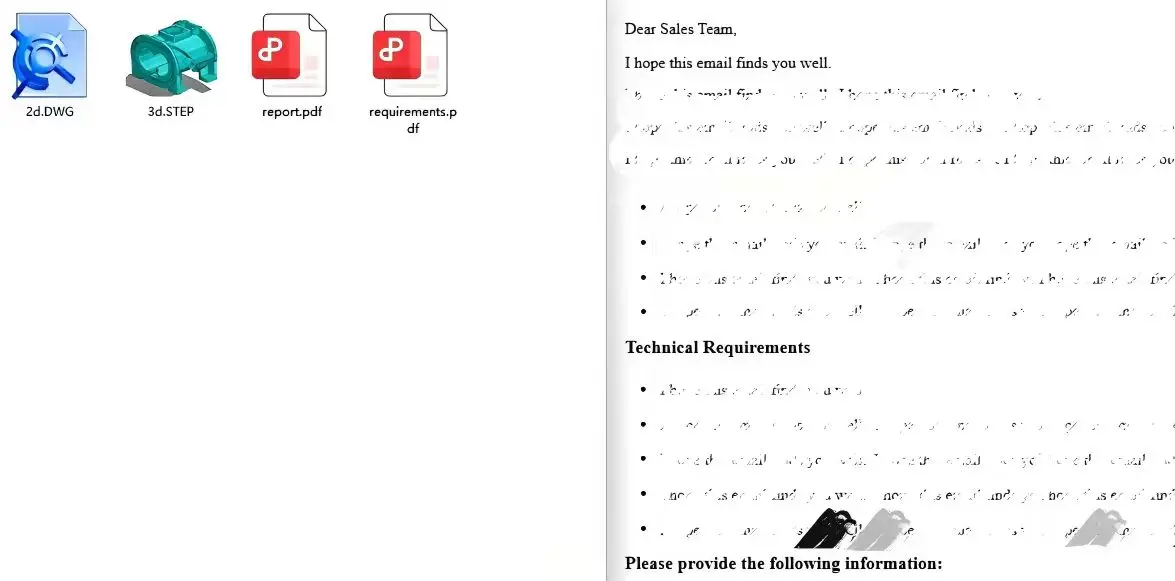
Send both the 2D drawing and the 3D model
In a dry screw pump housing RFQ, the 2D drawing and the 3D model serve different purposes. We prefer to receive both, because each file answers different manufacturing questions.
The 2D drawing is still the control document. It tells the supplier which dimensions are critical, which tolerances govern the part, which datum frame to inspect from, what material or heat treatment applies, what surface finish is required, and how the finished housing will be accepted. If the geometry is simple enough, a complete 2D drawing can support an initial quote review.
The 3D model helps with the manufacturing review. It gives the CAM programmer and process engineer a better view of the blank, tool access, fixture approach, internal cavities, and restricted features. On a dry screw pump housing, a flat drawing view can hide the relationship between holes, water channels, ribs, and internal passages.
We have run into this in our own housing work. On one new design, the team reviewed the part mainly from 2D drawings because the development schedule was tight. During machining, one screw hole broke into a water channel. It was not a critical dimension, and the leak point could be repaired by welding, so the test housing was still usable. But it added rework that a more careful 3D review could likely have caught before machining.
Version control matters here too. In production, old drawings can stay in circulation long enough for machining to follow the wrong version. A 3D model may also miss small radii or corner breaks that the casting or machining team later adds for manufacturability. If the buyer expects the finished housing to match every small radius in the model, that expectation needs to be written into the RFQ before the pilot order is judged.
A clean RFQ names the active drawing revision, the active model revision, and which file controls acceptance if the two do not match.
State material, coating, and application context early
Material, heat treatment, and coating notes should be settled early in the RFQ. They affect more than the blank price. They can change the machining route, cutting speed, tool choice, inspection plan, and the order in which the housing has to be processed.
Even when the housing size is the same, material can move the price sharply. An SS304 housing is usually much less expensive than the same housing made from SS316. It also machines differently. Stainless grades, cast irons, and coated routes may require different tools, feeds, speeds, and cutting assumptions, so a vague material note makes the quote unstable from the start.
Material naming can also create problems in international RFQs. In a recent housing inquiry, the customer specified stainless steel using a German material designation. In China, we could source a material with matching or comparable properties, but it did not carry the same name. The customer needed a material report to confirm the chemical and mechanical properties before approving the substitute, so the RFQ should name the material grade, standard, and any certificate or report the buyer needs for approval.
Application context belongs in the same discussion. Process gas, temperature, corrosion risk, and cleaning requirements can all affect whether the buyer chooses SS304, SS316, cast iron with coating, or another route. In our 304 versus Class 35 housing material guide, the material decision starts with gas chemistry and corrosion risk, not with cost alone.
The same inquiry also included a finished-part requirement: one machined face needed heat treatment to increase surface hardness. That note changes how the process is planned. The route may need rough machining, heat treatment, finish machining, protection for the treated face, and hardness inspection. If the treated surface, hardness target, or certificate requirement is not clear before machining, we would rather pause and confirm the requirement than start cutting and risk rework or scrap later.
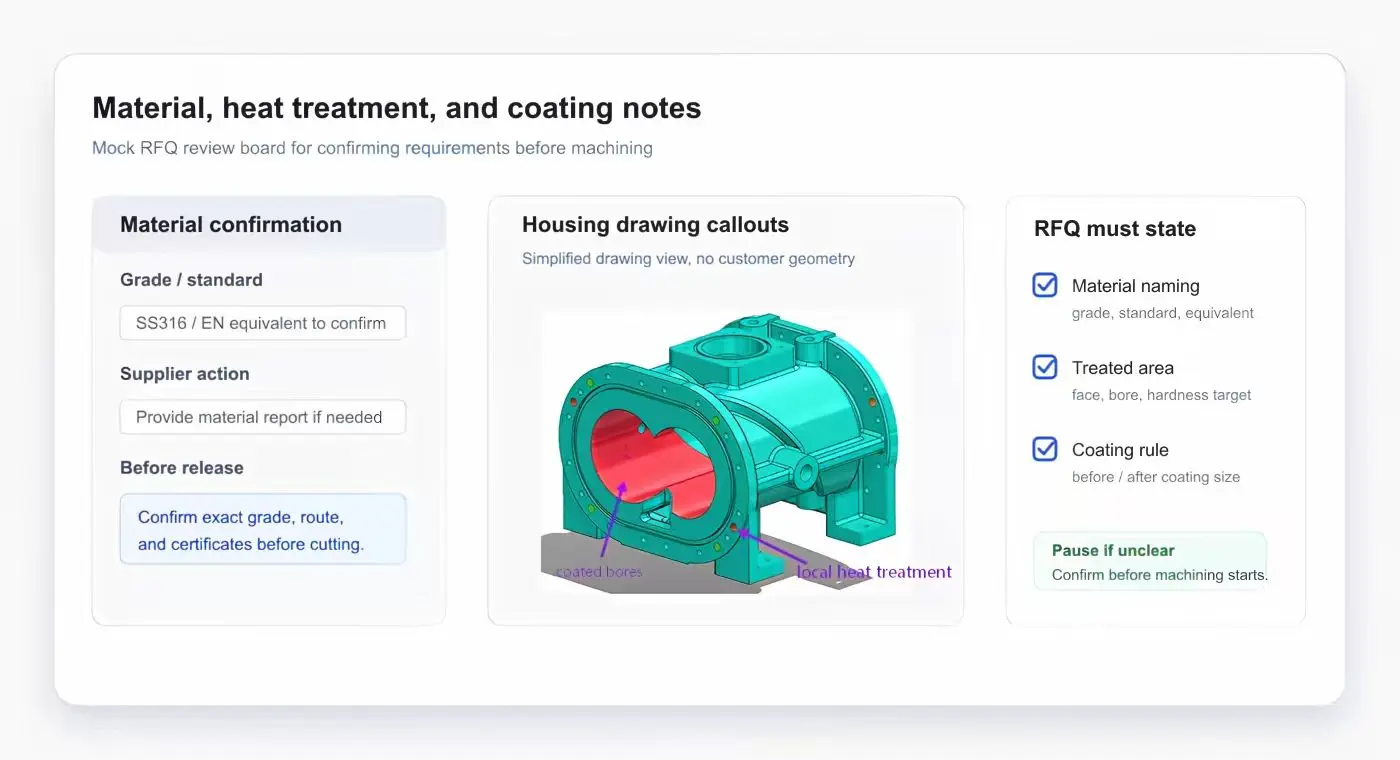
If only some surfaces need special treatment, mark them clearly on the drawing or in the RFQ note. A note such as special heat treatment required is not enough by itself. The supplier needs to know which bore, face, seal area, wear surface, or datum surface is treated; whether machining happens before or after treatment; and whether the buyer expects a hardness report, material certificate, or treated-face identification in the inspection package.
Coating also needs to be explicit. In our own pump housing work, housings may receive sprayed coating, and the dimensions before and after coating are not always the same. If the buyer needs coating, the best place to state it is on the drawing: which surfaces are coated, what the pre-coating dimensions are, and what the final post-coating dimensions must be. If the drawing shows only one bore size, the supplier may not know whether that is the machined size before coating or the accepted size after coating.
That ambiguity is expensive in international trade. If a housing is machined and shipped to the drawing size, but the buyer later says the size should have been interpreted as the post-coating size, the part may need secondary machining or rework after arrival. Once freight, customs, coating schedules, and project delay are included, the loss can be much larger than the original machining cost.
The RFQ should say:
- Coated surfaces - name which bore, face, or internal area receives coating so the supplier can plan allowance and masking.
- Final-size rule - state whether the critical size is accepted before coating, after coating, or both.
- Inspection expectation - say whether the buyer wants only the final coated size or both pre-coat and post-coat data.
- Supplier scope - clarify whether the machining supplier quotes coating, coordinates coating, or only machines before coating.
- Coating note on the drawing - include the coating requirement in the controlled file, not only in an email thread.
On our own coated bore work, a coated bore may need the pre-coat ID opened roughly 0.04-0.08 mm beyond the intended finished ID, depending on the coating plan and final clearance. That number should not be copied blindly into another design, but it shows why the RFQ has to define whether the bore is accepted before or after coating.
Define inspection and CMM report scope
For a dry screw pump housing, "CMM report required" leaves too much open. It does not tell the supplier which features to report, how much of the drawing to cover, or which datum frame should control the inspection.
In our own housing workflow, the CMM checks that carry the most weight usually include twin-bore parallelism, bore center distance, bore-to-face perpendicularity, end-face parallelism, and dowel or pin-hole location. Depending on the buyer's acceptance rule, the report may also include mounting-foot flatness, coated bore ID, or a full dimensional report.
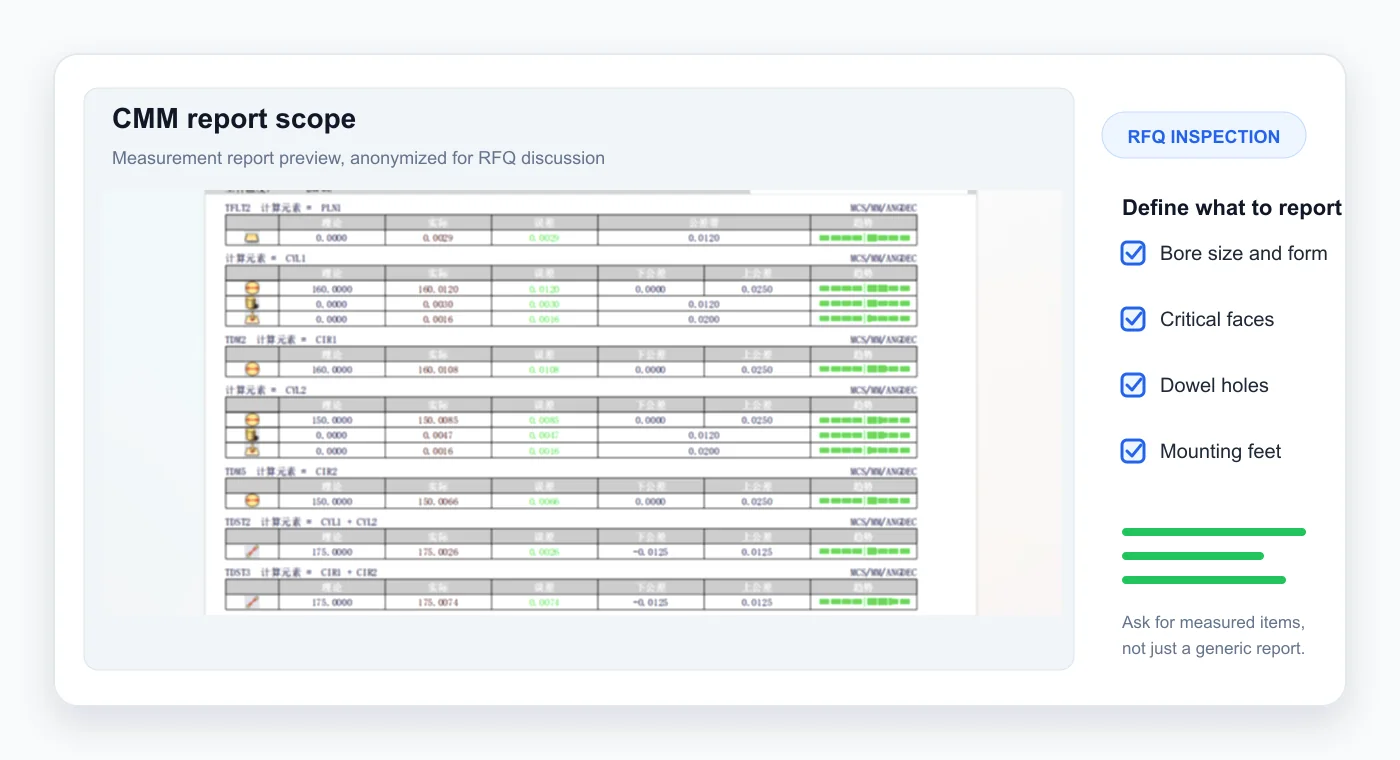
Those requests do not take the same inspection time. Reporting five critical relationships is different from programming and reporting every dimension on the drawing. A first-article full dimensional report is also different from a full report on every batch. The RFQ should state the expected scope before the quote is finalized.
| Inspection request | Better RFQ wording | Why it helps the quote |
|---|---|---|
CMM report required | Report twin-bore parallelism, bore center distance, bore-to-face perpendicularity, end-face parallelism, and dowel hole position | Gives the supplier a defined CMM scope to quote |
Inspect all dimensions | Full dimensional report for first article only | Avoids full-reporting assumptions on every batch |
Check coated bore | Report final coated bore ID after coating; pre-coat size can remain internal unless requested | Separates internal process control from buyer acceptance |
Use drawing datum | CMM report should use datum A/B/C from drawing rev __ | Keeps machining, inspection, and assembly datum from drifting apart |
Datum clarity belongs in the inspection scope too. If the machining datum, inspection datum, and functional assembly datum point to different references, the supplier has to quote with assumptions. In our own route, we often think from feet datum to end faces to bores, but the buyer's drawing may require a different acceptance frame. That can work, as long as the acceptance frame is visible before quote.
Include quantity, annual volume, and timing
Quantity matters because one housing and a batch of housings can have very different unit costs, even when the drawing is unchanged. The supplier needs to know whether the RFQ is for a one-off trial, a small pilot batch, or the first step toward repeat production.
For a trial order of one or two housings, we can sometimes use a flexible route, such as welded fabrication or lost-foam casting. Common materials leave more room for that choice. For less common materials, the supplier has to confirm whether the material can be welded safely, whether the joint design is acceptable, and whether a foundry is willing to prepare the required alloy for such a small order.
In a recent inquiry, the customer's housing was small, and the material was not a common stocked grade for the casting route. The foundry required a minimum of five housings before preparing the material and casting the blanks. The customer said that if the trial order passed, they expected to order twenty housings later. For the trial quote, we still had to explain that the material cost would be based on five housings. If the later order moved forward, we could credit the extra material cost from the trial batch in the follow-up quotation.
The RFQ does not need a full business plan, but it should at least say:
- First batch: __ pcs
- Estimated annual volume: __ pcs/year
- Target timing: __
- Repeat order expected (optional): yes / no / unknown
Target delivery date should be included, but it is not a fixed lead-time promise before the supplier reviews the route. Material, blank availability, machining access, coating, CMM reporting, and customer confirmation can all affect timing. With the target date visible, the supplier can flag timing risks before the quote is locked.
Commercial terms belong in the direct RFQ conversation, not in a technical checklist article. Payment terms, trade terms, price negotiation, NDA details, and customer-specific acceptance agreements should stay out of the blog. The blog should focus on the technical and inspection inputs that change quote assumptions.
Send mating-part context only when it controls the housing
End-cover, front-plate, rear-plate, or mating assembly information belongs in a housing RFQ when it affects how the housing will be machined, inspected, or accepted.
The buyer does not always need to send the full pump assembly. If the housing drawing is self-contained, the housing drawing package is usually enough for quote review. Mating-part context is needed when it defines a datum, sealing face, dowel alignment, bolt pattern, bore-to-face relationship, CMM report scope, or a dimension that cannot change.
For example, if an end cover locates through dowel holes and the housing drawing asks those dowels to be checked from the bore datum, that relationship should be visible in the RFQ. If a sealing face on the housing is accepted against a mating cover face, the supplier needs to know which face is functional and which surface finish or flatness requirement controls acceptance.
There is a clear boundary. SCPM can review how the housing will be machined and inspected, but final pump performance geometry remains with the OEM or design owner. We do not decide rotor clearance, pump performance geometry, screw rotor profiles, proprietary stage features, or reverse-engineer customer designs. Our comments stay on housing manufacturability, inspection feasibility, datum clarity, coating allowance, and quote assumptions.
What happens when RFQ information is missing?
Missing RFQ information does not always stop the quote, but it turns part of the quote into a written assumption.
At the first review stage, that can be acceptable. Buyers may not have every answer ready. The risk is hidden assumptions: a supplier may quote a limited CMM report while the buyer expects full dimensional reporting, or quote a machined bore size while the buyer expects final size after coating. Both sides think they are aligned until the first article is inspected.
An incomplete RFQ does not have to block the first review. Before formal machining starts, our engineers confirm open points with the customer by email, WhatsApp, or the buyer's preferred communication channel. Missing information needs to be identified and closed before material is committed, fixtures are made, or machining begins.
| Missing item | Quote assumption likely needed | Buyer risk |
|---|---|---|
| No 3D model | Quote starts from the 2D drawing only | CAM access, internal passages, and blank risk may appear later |
| Drawing/model revision mismatch | Supplier asks which file controls acceptance | Part may match one file and fail another |
| Material grade unclear | Supplier quotes a baseline material by assumption | Cost, machining time, and corrosion route may change |
| Local treatment surfaces unclear | Supplier quotes machining without a defined treatment route | Finished-part hardness, wear surface, or post-treatment inspection may be missed |
| Coating before/after rule unclear | Supplier assumes pre-coat or post-coat acceptance | Bore size disagreement after coating |
| CMM report scope unclear | Supplier quotes limited or full report by assumption | Inspection cost mismatch |
| Mating datum unclear | Supplier picks a practical machining or inspection datum | Assembly acceptance may use a different frame |
| Quantity missing | Supplier quotes pilot economics | Repeat-production price may change |
| Target timing missing | Supplier cannot judge route timing risk early | Blank, coating, CMM, or approval delay appears later |
A better RFQ does not need to be longer. It shows which questions are settled and which assumptions are still open.
RFQ email template for a dry screw pump housing
For a housing drawing with coating, CMM, datum, or mating-part questions, a short structured RFQ email is easier to review than a long message thread.
Part: dry screw pump housing / pump body
Attached files
- 2D drawing rev __
- 3D model rev __
- Assembly or mating reference, if needed
Material
- Grade / standard: __
- Heat treatment or special material note: __
- Locally treated surfaces / functional faces: __
- Required hardness, treated condition, or certificate: __
Coating / surface treatment
- Coated surfaces: __
- Final size accepted before coating / after coating / both: __
- Coating handled by buyer / supplier / not decided: __
Inspection
- CMM report scope: __
- Datum frame for report: __
- First article full report required: yes / no
Quantity and timing
- First batch: __ pcs
- Estimated annual volume: __ pcs/year
- Target timing: __
Application notes
- Process gas / condensate / operating temperature, if relevant: __
- Mating-part datum or sealing context, if relevant: __
Design boundary
- Dimensions that cannot change: __
- Dimensions open to DFM comments: __
This format gives the supplier a defined manufacturing scope to quote. It also leaves the buyer with a clearer written record when the quote turns into a purchase order, first article, and inspection report.
What SCPM can review, and what the OEM must confirm
SCPM's RFQ review stays on the housing side: manufacturability, blank route, datum clarity, coating allowance, inspection feasibility, and quote assumptions.
Within that scope, we can flag a missing 3D model, a vague material note, a coating-before or coating-after question, an oversized CMM scope, or a mating datum that needs clarification before machining. We can also point out when a drawing appears to carry copied tolerance habits from an older template.
Final design decisions stay with the OEM or design owner. Rotor clearance, pump performance geometry, screw rotor profiles, and proprietary stage features are not supplier decisions. If the buyer wants feedback from our dry screw vacuum pump production experience, we keep that feedback tied to housing manufacturing and inspection rather than pump redesign.
For supplier-side review after the RFQ arrives, see our dry screw pump housing DFM review. For tolerance-specific quote risk, see Dry Screw Pump Housing Tolerances Before Quoting.
Can I get a dry screw pump housing quote with only a 2D drawing?
Yes, a supplier can usually start a first review from a complete 2D drawing, but the quote will carry more assumptions without a 3D model. The 2D drawing controls dimensions, tolerances, datum, notes, and inspection requirements; the 3D model helps with CAM, blank review, tool access, and revision control.
Do I need to send the full pump assembly for a housing RFQ?
Not always. Send mating-part or assembly context only when it controls the housing datum, sealing face, dowel alignment, bolt pattern, CMM report scope, or acceptance logic. SCPM can review housing manufacturability, but final pump performance geometry stays with the OEM or design owner.
Should coated bore dimensions be inspected before or after coating?
The RFQ should state whether coated bore dimensions are accepted before coating, after coating, or both. If the final bore ID is controlled after coating, the drawing should identify the coated surfaces, pre-coating size rule, and final post-coating acceptance size.
What CMM report scope should I ask for on a dry screw pump housing?
Ask for the features you need reported, not just "CMM report required." A practical scope may include twin-bore parallelism, bore center distance, bore-to-face perpendicularity, end-face parallelism, dowel or pin-hole location, mounting feet, and coated bore ID.
Does annual volume change the dry screw pump housing quote?
Yes. One trial housing and repeat production may not use the same blank route, material purchase, or inspection economics. For uncommon materials, a foundry may require a minimum blank quantity before casting, so first-batch quantity and estimated annual volume help the supplier price the trial order without hiding material assumptions.
What if my RFQ package is not complete yet?
An incomplete RFQ can start a first review. Before formal machining starts, SCPM engineers confirm open points by email, WhatsApp, or the buyer's preferred channel so material, fixtures, coating, inspection, and acceptance requirements are closed before work begins.

Share your thought
Your email is kept private and only used to notify you of replies.