
How we'd pick between 304 and Class 35 gray iron
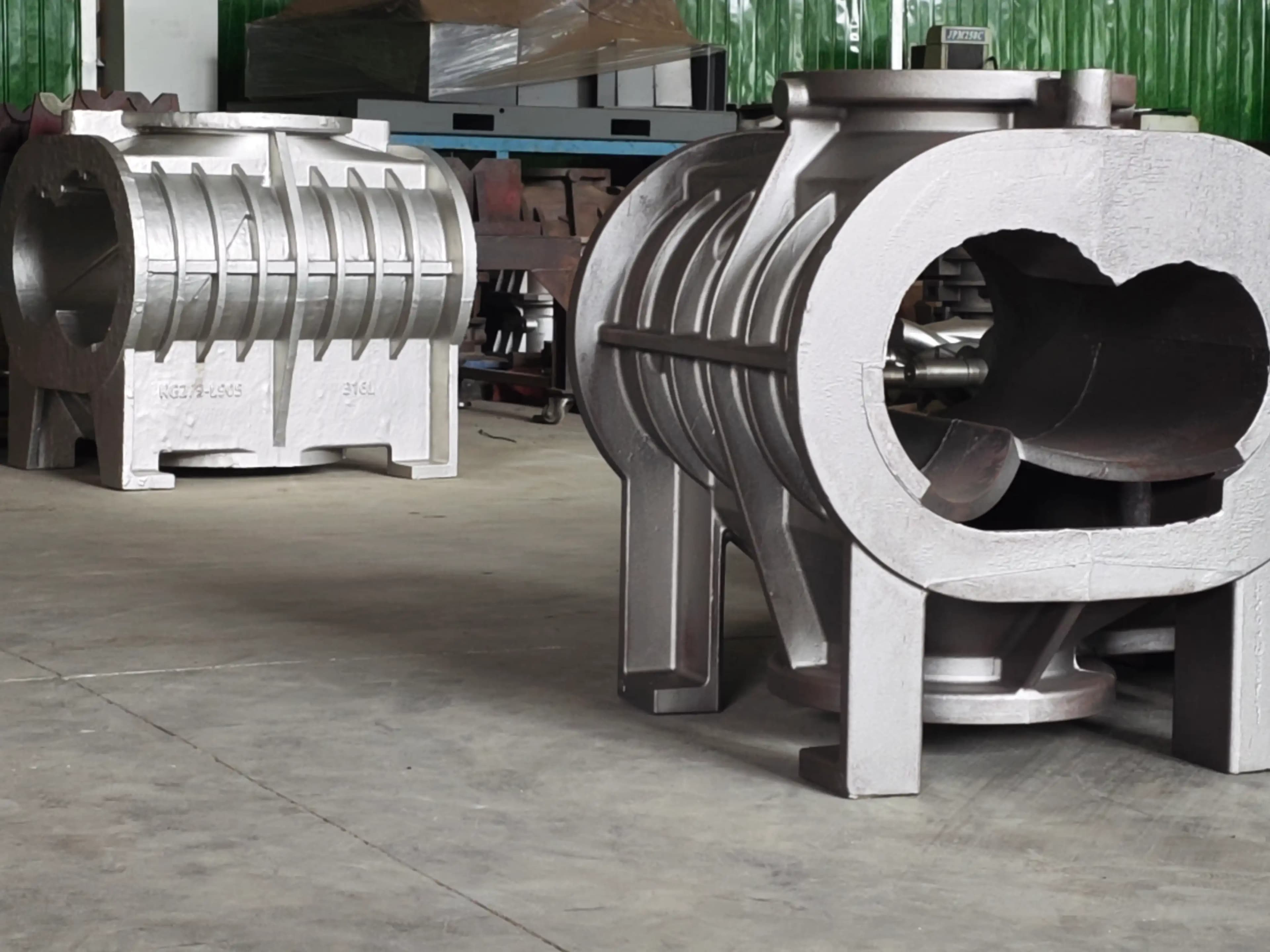
Process gases entering a dry screw vacuum pump housing are usually corrosive in some form, which is why getting the material right matters more on this part than on most of what we machine. Back when I was on the R&D side at the vacuum pump factory, the first step on every new order was a technical exchange with the customer — not about the housing geometry, but about the gas: composition, concentration, what condenses on shutdown. Once we had that, we'd come back with a material recommendation. Customers usually arrive with their own answer based on industry habit — most commonly 304 stainless, and on the more conservative side, 316. Where we can save them cost and lead time without giving up corrosion resistance, we pull from what we've shipped and what's come back from the field, and propose Class 35 gray iron with a corrosion-resistant coating instead.
That's why our default proposal — when a customer hasn't locked the material yet — is coated Class 35 gray iron. We've shipped enough housings into the field to know which gas chemistries a good coating handles and which ones it doesn't, and that experience is usually a cheaper input for the customer than picking 304 on principle. Solid 304 (or 316, for more aggressive species) earns its place when the customer's spec contractually requires it, or when we've walked through the gas chemistry together and the application sits in a band where a coating isn't worth the risk.
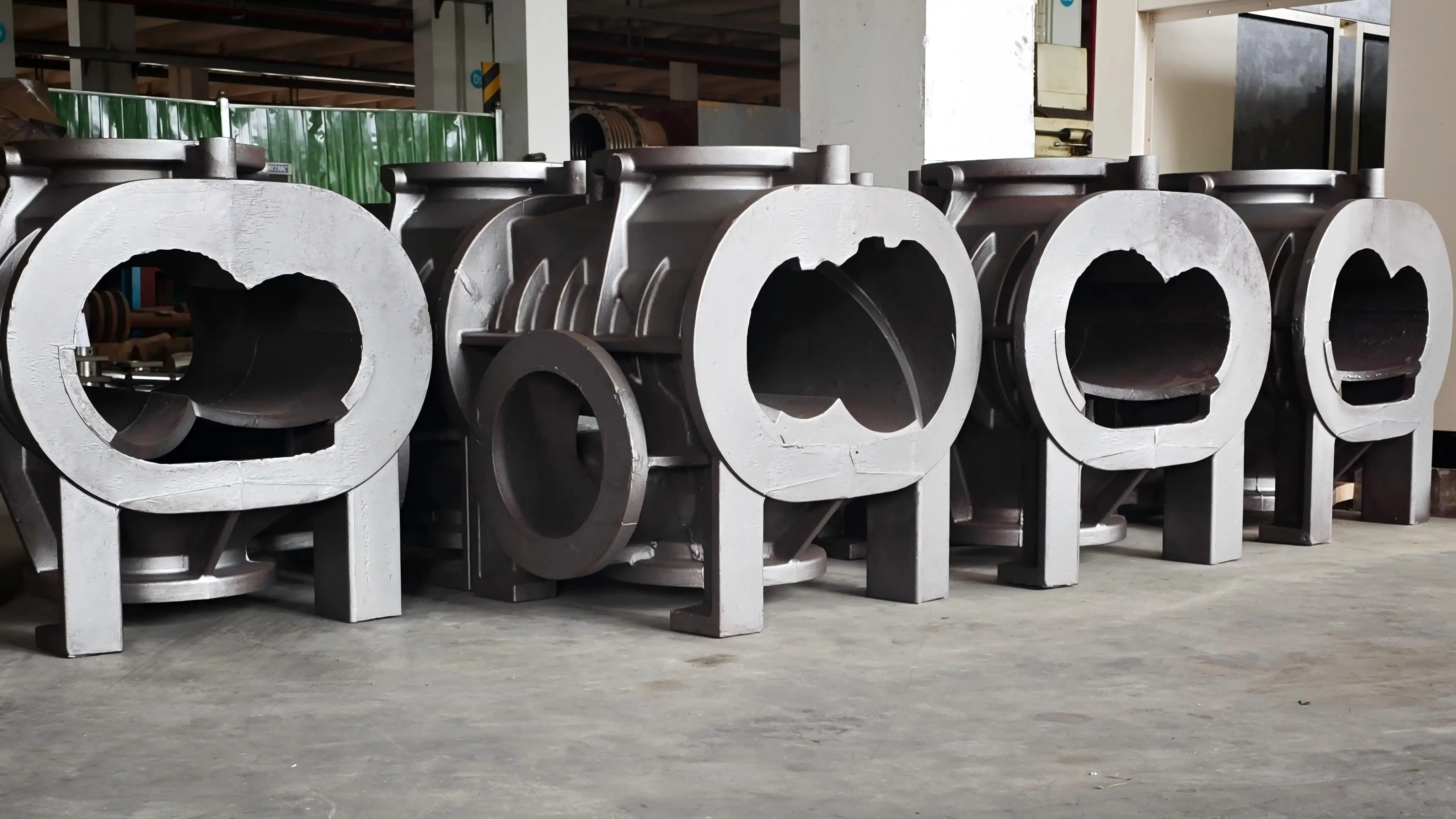
For pilot orders, the blank route doesn't change with the material — Class 35, 304, and 316 all pour through our foundry partner on the same lost-foam line, with the same pattern, slurry, and pour, only the alloy in the crucible changing. Lost-foam is specifically the pilot-volume route here: no hard tooling to amortize, which keeps the per-piece cost workable at 1–5 blanks. Once a design moves into true production volume, the foundry shifts off lost-foam to a tooling-backed casting route where per-blank cost drops; the cost and lead-time numbers below assume the pilot stage. If you've read our cast-vs-welded pilot post, don't read "lost-foam" there as a stainless-only route either — gray iron sits on the same pilot lead-time profile and the same blank-quality assumptions hold.
Where the cost gap actually lives
The cost gap between a 304 housing and a Class 35 housing lives in three places: raw blank price, machining time, and scrap risk. The 4× material ratio is the visible layer on a first quote; the 3.8× machining gap lands later, on the shop floor. The scrap-risk asymmetry is a production-volume tail more than a pilot-stage cost: at 1–5 blanks you may or may not catch a casting defect. Once volume runs, the Class 35 blanks that hide porosity or sand inclusions start showing up on the finishing pass — deep into machining hours, with nothing to recover.
| Dimension | ASTM A48 Class 35 gray iron | 304 stainless | Verdict |
|---|---|---|---|
| Lost-foam blank cost | ~$2.5/kg (~$250 on a 100 kg housing) | ~$10/kg (~$1,000) | Class 35 — ~4× cheaper, ~$750 saved per 100 kg housing |
| Total machining cycle time (same housing, same fixturing) | 1× (baseline) | ~3.8× | Class 35 — much faster, mostly on roughing |
| Roughing time ratio | 1× | ~4× | Class 35 — insert wear on 304 drives roughing time |
| Finishing time ratio | 1× | ~1.7× | Class 35 — the gap narrows when cuts are light |
| Sealing-face Ra achievable (stable, in production) | Ra 0.8 µm | Ra 0.8 µm | Tie — finish is a process question, not a material one |
| Sealing-face Ra 0.4 µm achievable | Yes, with the right CAM program | Yes | Tie — same answer, also process-driven |
| Use when | General industrial process gas, cost is a driver, no corrosion attack on iron | Process gas attacks iron and coating isn't acceptable to the customer | — |
Numbers above are for a representative dry screw vacuum pump housing in the 175 mm bore-centerline class, pilot batch in lost-foam blanks. Absolute prices move with alloy market and foundry pass-through; the ratios are what we plan around.
The related dry screw pump housing machining scope explains where material choice connects to bore parallelism, sealing faces, and inspection.
Roughing 304 isn't slower because the metal cuts slower — it's slower because the inserts don't last. We run the same process sequence on both materials (rough → semi-finish → finish on the same 4-axis HMC), but on 304 the operator changes inserts inside a single roughing cycle, which on Class 35 would run a full housing on one set. We optimize 304 with reduced depth-of-cut, controlled feed, and a more conservative tool path; even with those choices, total cycle lands at roughly 3.8× Class 35. The finishing-pass ratio drops to 1.7× because cuts are lighter and insert wear isn't the constraint anymore.
Two failure modes that don't show on a quote
The materials don't fail the same way, and the asymmetry matters for the cost decision. Class 35 gray iron can hide porosity and sand inclusions inside the blank that only surface during the finishing passes. When they show up at that depth, the housing is scrap — there's no rework path on a casting defect that's already past the critical surface. We catch some on incoming dimensional qualification at the foundry and more on rough machining, but the ones that survive to the finishing pass cost us the full blank plus the rough-machining hours already burned. 304 fails by tool wear, not by scrap. Inserts wear out faster, the cycle stretches with the extra changeovers — but the housing finishes, and we've never had a 304 housing scrap on us from a machining-induced failure.
On the pilot orders we quote today, that scrap-risk tail is on us — when a Class 35 blank reveals a sand inclusion at the finishing pass, the shop eats the blank and the rough-machining hours. We've sized that into how we price Class 35 pilots, so the customer doesn't see it on the quote. Once the same design moves to production volume, that arrangement stops scaling. The foundry's incoming-blank gating becomes the load-bearing quality control, and the porosity acceptance criteria need to live on the customer's drawing, not stay as a private arrangement between us and the foundry.
When a 304 callout on the drawing isn't load-bearing
A 304 callout is not always a corrosion requirement; on inherited pump drawings, it can be a copied default that needs to be checked against the actual process gas. We see this when a stainless note moves from an old industry template into a new housing print. The original application may have involved a more corrosive vapor, while the new pump line sees a milder exposure. A paper-mold customer brought us that version of the problem: 304 stainless was the familiar default in their vertical, but the gas condition on this pump did not justify treating solid stainless as the only safe route.
We did not ask them to accept Class 35 from a drawing note alone. We took a Class 35 coupon, applied the same corrosion-resistant coating we'd use on the production housing, and immersed it for one week in a solution matched to the corrosive level of their process gas. The coating showed no measurable corrosion, and we saw no underfilm attack at the cut edges. The customer accepted coated Class 35 for the housing, and the per-housing cost came down by roughly half against the original 304 quote.
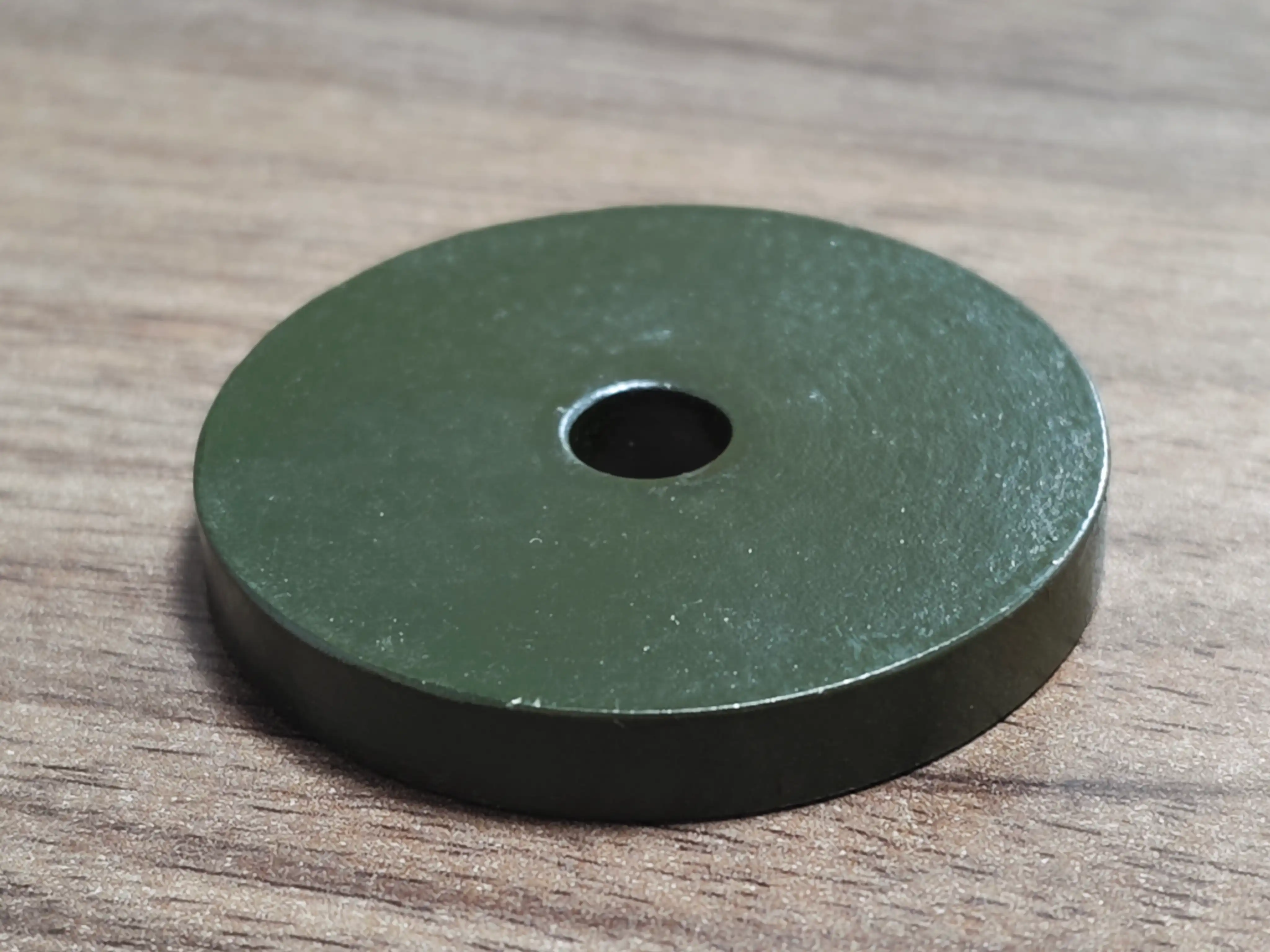
When the customer has not named an alloy yet, we use the same route. We start with the process gas and condensate, then decide whether coated Class 35 deserves a test before anyone pays for 304. If the exposure looks mild enough for a coating route, we can provide a coated Class 35 coupon for the customer to validate before the housing material is changed. If the coupon passes, the customer gets a tested lower-cost route instead of paying for stainless by default.
When Class 35 is the wrong call
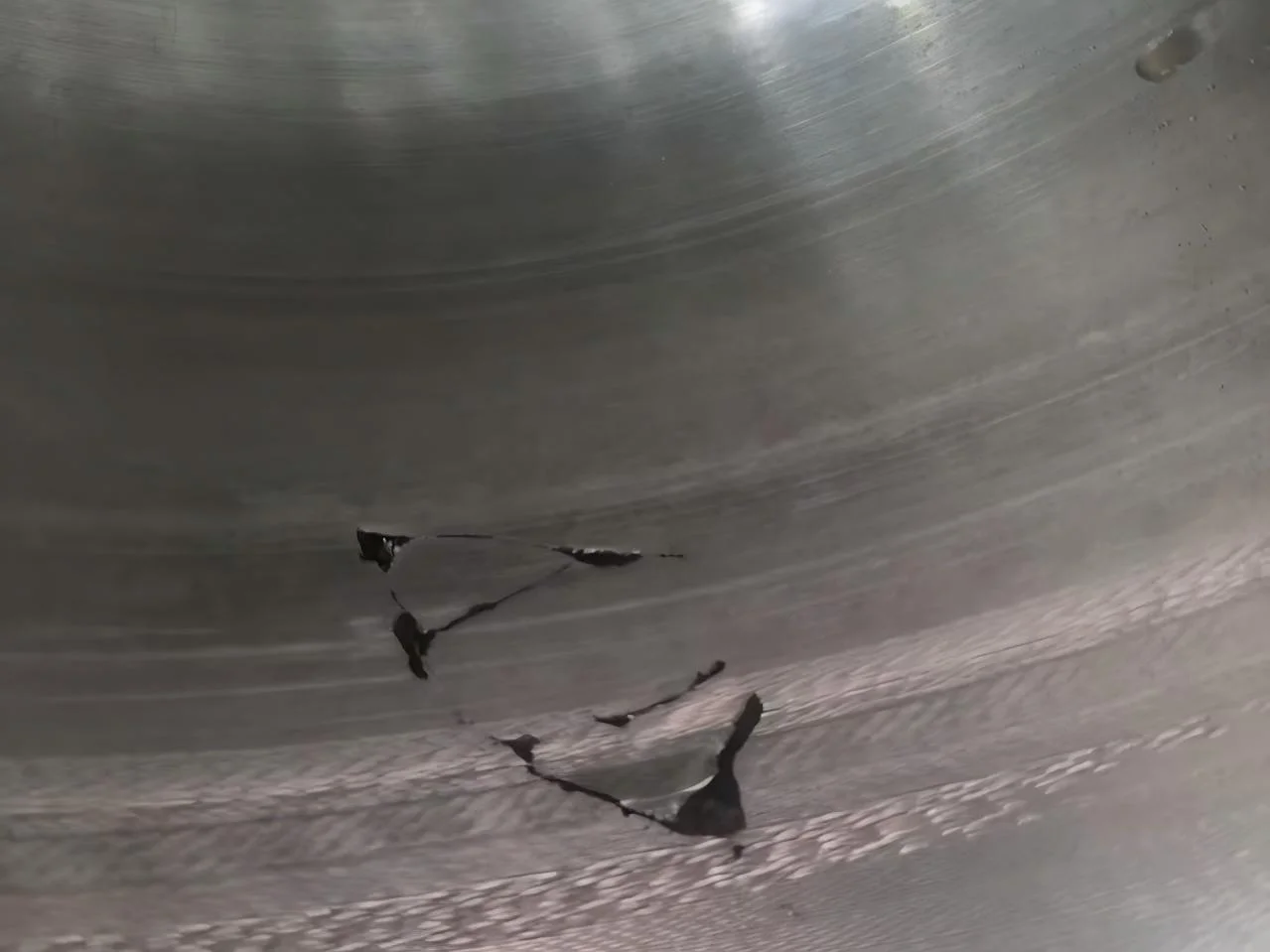
Class 35 is the wrong call when the gas chemistry is incomplete, or when the process can expose the housing to corrosive species the drawing does not mention. A separate customer came in for a Class 35 head: general industrial application on paper, no corrosion notes on the inquiry. About a month into operation, the pump stopped hitting its rated vacuum and the motor current climbed, so the customer pulled the head and sent it back. The missing detail was the process gas. It had attacked the iron enough to open the rotor-to-bore clearance into backflow territory, which explains the vacuum drop and the higher motor draw. At that point the head was scrap. The customer re-ordered a corrosion-resistant version, and the replacement has been running.
The fix was on the intake side, not in the housing geometry. We now ask up front about the working gas, condensate behavior on shutdown, and process upsets that could expose the housing to chemistry outside the steady-state nameplate. Those three answers decide whether the route is bare Class 35, coated Class 35, or solid 304. Getting them wrong costs more than starting with a conservative material.
How to spec material on the drawing
A useful material callout for a dry screw pump housing should tell the machine shop why the alloy was chosen, not just name 304 or Class 35. We are not the pump OEM making the final process decision, but these six notes let us quote the housing honestly, flag corrosion risk early, and suggest a coated Class 35 coupon test when the drawing looks over-specified.
- Process gas chemistry — the actual species and concentration the housing will see, not "industrial gas". This tells us whether the material note is load-bearing or only a drawing default.
- Condensate behavior on shutdown — whether anything condenses inside the housing when the pump stops. Standing liquid attacks materials differently than the working gas does.
- Operating temperature range — corrosion rates aren't linear in temperature, and a gas that's inert at 80 °C may not be at 180 °C.
- Coating acceptability — whether your end customer or your QA process accepts a coated Class 35 housing as equivalent to a solid 304 housing, or whether the solid stainless is contractually required.
- Sealing-face Ra requirement — Ra 0.8 µm is the default we hold on both materials; tighter Ra is a process spec, not a material spec.
- Inspection and acceptance — whether you want porosity/inclusion gating beyond standard foundry incoming qualification on Class 35 blanks.
What we'd rather not see is a bare "304 stainless" callout with no application context. We can machine the housing exactly to that note, but we cannot tell whether the customer is paying for corrosion resistance they need, or for a default that followed the drawing from an older pump.
Where this leaves you
For a dry screw vacuum pump housing with no corrosion driver, Class 35 gray iron is usually the lower-cost machining route. Once corrosion enters the service condition, the buyer needs to decide whether coated Class 35 can be validated, or whether the drawing has to stay with solid 304.
As the machining supplier, we can quote either route, flag the cost and machining trade-off, and provide a coated Class 35 coupon for testing against the customer's gas chemistry before the housing material is changed. For the geometry side of the same housing, see our twin-bore parallelism post, and use the housing tolerance review before quoting when coating allowance or CMM scope changes the acceptance plan. The full housing-side machining specs live on the dry screw vacuum pump housing machining page.
FAQ
Can a dry screw vacuum pump housing be made of cast iron?
Yes — ASTM A48 Class 35 gray iron can be used for a dry screw vacuum pump housing when the process gas and condensate do not attack iron. As the machining supplier, we treat it as the lower-cost option to quote when the application allows it; stainless steel becomes necessary when the customer's process gas, contract, or coating policy rules out bare or coated Class 35.
How much cheaper is a Class 35 gray iron housing than a 304 stainless one?
Raw lost-foam blank cost is roughly $2.5/kg for Class 35 versus $10/kg for 304 — about a 4× ratio. On a 100 kg housing blank that's $250 versus $1,000 before any machining. Machining widens the gap: total cycle time on 304 runs about 3.8× longer than the same housing in Class 35, driven by tool life on the roughing passes.
If we coat a Class 35 housing for corrosion, is it really equivalent to 304?
Not automatically. A coated Class 35 housing is only a 304 alternative after the coating is validated against the customer's actual gas chemistry and acceptance rules. In the paper-mold case, we coated a Class 35 coupon, immersed it for one week in a solution matched to the customer's process gas, saw no measurable corrosion, and the customer accepted the substitution. Coating thickness, edge coverage, and re-coat policy after rework still need to be part of the spec.

Share your thought
Your email is kept private and only used to notify you of replies.